|
Aligning your satellite dish for Sky Digital
Welcome to this guide on how to align your satellite dish for Sky Digital. The group of satellites that are used by Sky to transmit the signals are known as Astra 2
and have an orbitting position of 28.2 degrees east. This does not mean you can get a compass and simply point the dish at 28.2 degrees east, the 28.2 degrees refers to the position of the
satellite over the earth’s equator. You will remember that 0 degrees is the imaginary line that runs from the northpole to the southpole through Greenwich in London (hence GMT=Greenwich Mean
Time), thus meaning that if we were to start at the equator on the 0 degree line and move eastwards until we were 28.2 degrees around the world (the earth is made up of 360 degrees) and stopped,
looked directly upwards, we would be looking at the satellite! Obviously we wouldn’t see it with the naked eye because it is that far up but in the sky hovering in a geostationary orbit.
So now we know where the satellite is roughly and all that remains is to point the dish at it!
- First we find an ideal place to put the dish. The general rule of thumb is
to put the dish somewhere where the sun can shine on it between 10 am and 12 noon as the sun, as viewed from the earth, will be roughly in the same position as the satellite between those times.
Make sure that there are no trees with or without leaves, washing lines or other obstuctions in the line of sight of the dish.
- Connect the lnb (the unit at the end of the arm that protrudes from the
dish) via a satellite type coax cable (identifiable as it has a silver or blue foil in addition to the sheath screen) to the digibox. Connect the TV to the digibox by using a Scart cable to
ensure best picture quality. You can also connect the digibox to the TV via the RF aerial socket but unless you are using a TV that you bought in the UK, you will get a picture but no sound as
the digibox uses the UK PAL1 as opposed to the european PAL B/G.
- Now connect the digibox to the mains electricity (in europe 230V is
standard) and switch the digibox on. You will most probably get the message “No satellite signal is being received”. This is because the dish isn’t alligned with the correct
satellite yet.
- Using the Sky Remote Control, Press “Services” and then press
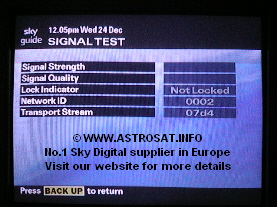
number 4 and then number 6. You will now see the Signal Test screen as shown in [Fig 1]. You will see “Signal Strength” (SS) “Signal Quality” (SQ
) “Lock Indicator” (LI) “Network ID” (NI) and “Transport Stream” (TS). The NI and TS
are what we will be concentrating on for the time being.
- Turn your dish so that the face of the dish is near vertical and is pointing
true south (you may need to use a compass for this).
- Now whilst watching the TV screen, very s--l--o--w--l--y turn the dish
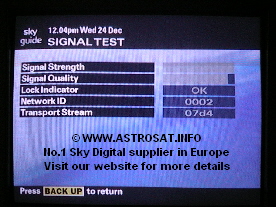
towards the east until you see the NI change from “0000” to “0002” and TS change from “0000” to “07d4”.
Be carefull though and make sure you turn the dish smoothly and slowly as it takes a few seconds for the digibox to react to the weak signals from the satellite. Once you have found the correct
satellite you may also hear music in the background and the LI will have changed from “Not Locked” to “OK” as in [Fig 2]. If this doesn’t
happen repeat No. 6 until you have turned the dish too far east to ‘ESE’ (east-south-east) in which case you will need to alter the verticle angle of the dish slightly upwards turn
the dish back to true south and then restart No. 6.
- Now we concentrate on the SS and SQ! Adjust the dish up and
down very slowly until the SS has peaked. Now turn the dish very slightly eastwards and westwards until the SS has peaked again. The SQ should now also be relatively high but
if it’s not quite 100% don’t worry. The skew is all that is left to adjust now and this entails slackening and then rotating the lnb in it’s holder cloickwise and anticlockwise
until the highest SQ is attained.
- Once you are sure that you have the highest SS and SQ
readings tighten all the bolts and secure the lnb cable securely to the dish arm and bracket so that it doesn’t flap about in the wind causing the cable to break.
Now you may have had problems and are still not getting the signal, in which case, make sure you turn the dish very very slowly because turning the dish too quickly will
mean you will move it through the beam and out the other side before the digibox can react to the change in signal strength.
|